Your Buyer’s Journey Starts Before the First Search
A B2B buyer’s journey is convoluted, to say the least. You see, the problem with mapping their journey are the stretches that sit outside of any buyer journey map, like friction, dialogue amongst peers, word of mouth, vetting it against competitors, etc.
Most standard models define a B2B buyer’s journey as a straight line, where the buyer goes from awareness to consideration, and finally, to decision. While this isn’t wrong, it’s oversimplified—especially given how AI is redefining the trail.
TL;DR
- The B2B buyer journey is the path a buying group takes from friction to a signed vendor decision, spanning multiple stakeholders and stages.
- The B2B buyer journey moves through pressure points, questions, and verification touchpoints—with AI chatbots now shaping research well before a buyer reaches a vendor's site.
- The B2B buyer journey matters because buying groups now span 6 to 13+ stakeholders, and mapping their real questions produces stronger content and higher trust than a traditional funnel does.
What are the buyer journey stages in a B2B buying process?
Gartner’s research talks about a B2B buyer’s journey as “buying jobs”, instead of a linear stages. The buckets for the buying jobs are:
- Problem identification
- Solution exploration
- Requirements building
- Supplier selection
The research also posits that buyers loop back through them rather than finishing one and moving to the next.
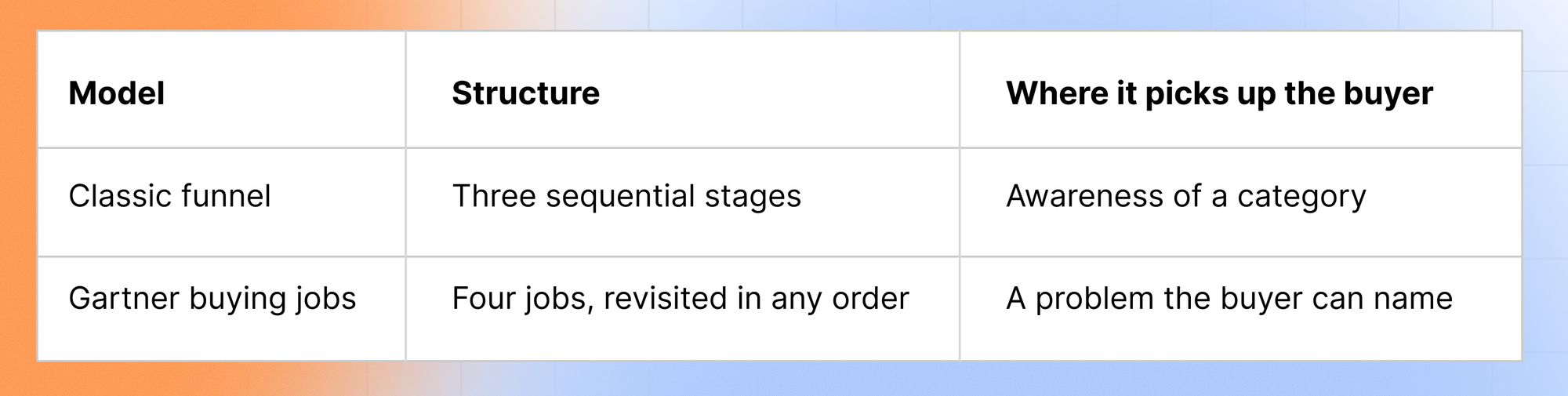
something is wrong. Gartner maps the buying process and so problem identification is the right place to begin with. But marketers borrowing it to treat it as the whole journey is where it starts to go sideways.
So here's what to actually do about it.
How to map a B2B buyer journey: the question-based framework
To understand how to map a buyer’s journey you need to understand that the journey implies your buyer walks it from start to finish, in order, leaving footprints you can retrace later. While that’s a neat picture but it has a lot of friction. What your buyer actually does is carry an unresolved question through several different rooms:
- Chatbots
- Peers
- Review sites - G2, Capterra
- Pricing page
And they are checking it against each other. This is what b2b customer journey mapping should actually look like, and I'll walk through how to fill it in for your own buyers in a second:
You build this back from what you have - not from a template.
- Pull your real pressure points from win-loss notes and support tickets.
- Write the question a buyer would put to a chatbot or a peer.
- Run those questions yourself, across two or three AI models.
- Audit your comparison, pricing, and case study pages against the narrower questions.
- Put what you find into the table above, row by row.
B2B buyer research process, stage zero: before the search
Before your buyer pins the problem, or even names it, there's a feeling—probably too vague to type into a search bar. And that’s exactly why your row one should ideally come from win-loss sales calls, support tickets, or SME interactions.
So where do B2B buyers start their research process
G2's March 2026 survey of 1,076 B2B decision-makers found that 51% now begin the purchasing process in an AI chatbot rather than a search engine—a majority, for the first time, choosing a conversation over a results page. And this is happening just once on one LLM, your buyer’s triangulating information from different sources and across multiple models.
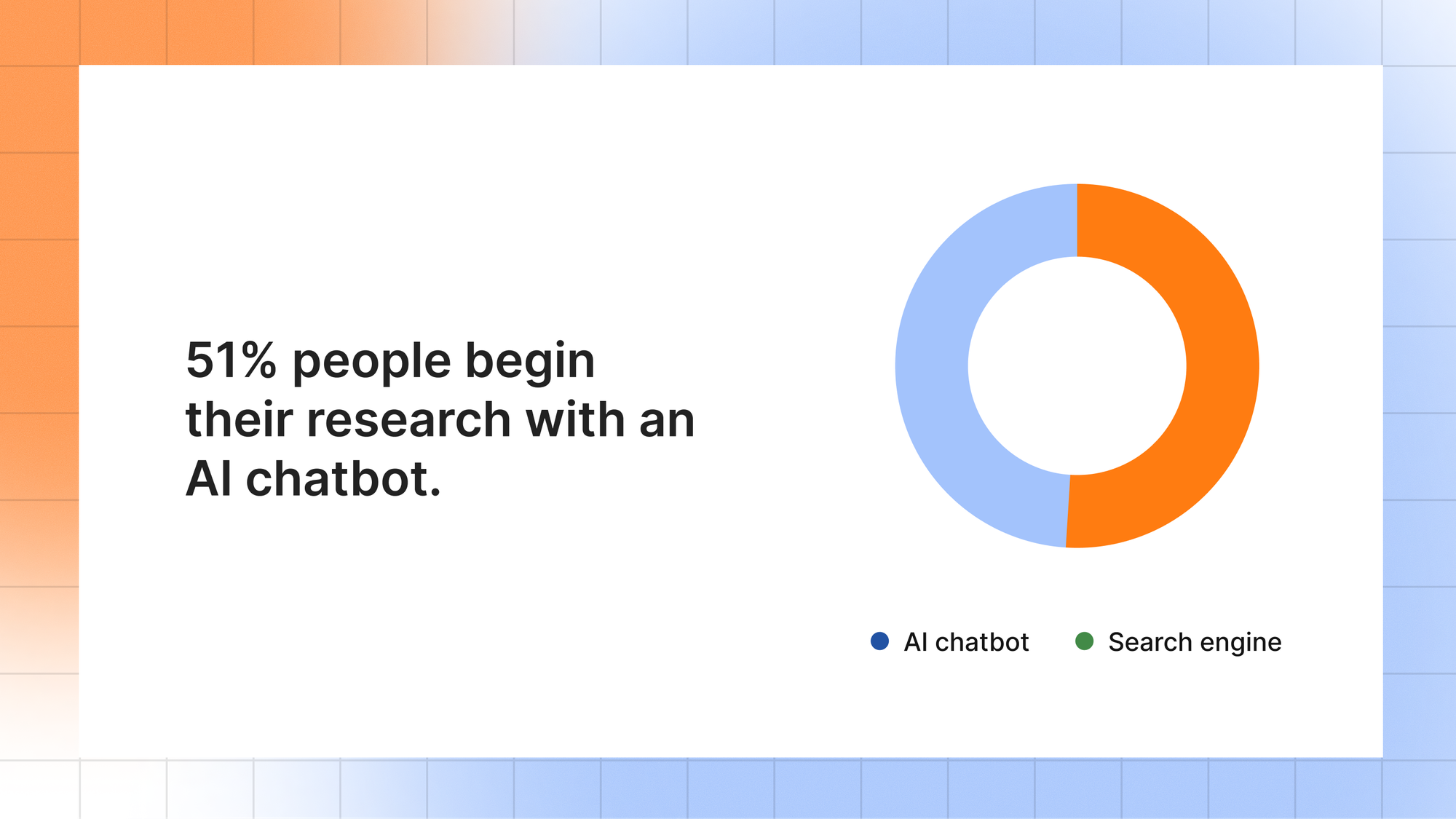
And here’s where it gets a little uncomfortable: the answer is already narrowed. The average shortlist has shrunk to roughly 2.5 vendors, down from 3.2—more information available than ever, and fewer vendors making the cut. All because an AI model is filtering before the buyer gets his answer.
G2's Tim Sanders puts it as three eras of compression: "Yellow Pages to the big book" gave way to Google narrowing things to the first page, and now chatbots narrow further still, down to a single answer.
Which is the whole stake behind row 3. If you're not one of the names a model surfaces when someone asks your category's version of "what handles this," you're narrowed out before you ever get a chance to compete.
B2B customer journey touchpoints
When a model does the narrowing, what’s left for the buyer is to verify the output themselves—review sites, peer conversations, your website—the real b2b customer journey touchpoints. The job description for your site has changed.
It went from being the only place where b2b buyers came for end-to-end information, to fact check what the models are claiming about you. Which is exactly why your comparison pages, pricing pages, case studies need to be written meticulously.
How B2B buying groups make the final decision
By the time a b2b buying group sits down to decide, the spec comparison has mostly done its work already. Demand Gen Report found industry expertise now outranks both price and product fit as the most significant factor in final vendor selection—52% citing expertise, against 49% for price and 46% for product fit.
Visible expertise in your category is the thing that seals the deal. There’s a caveat worth mentioning: Forrester found that 81% of buyers end up dissatisfied with the vendor they eventually chose.
It’s one thing to be confident and boast about having expertise, but your product should follow. Building this to win deals isn’t going to hold up for long if your churn rate is higher than what it should be.
Who's actually in a B2B buying group
Row five talks about "group" like it's one entity making one trust call. Forrester's 2026 State of Business Buyings says that the average buying decision rests with 13 internal stakeholders and 9 external influencers. Gartner’s numbers are more conservative - at about 6 to 10. But the direction agrees either way: nobody's buying alone anymore, and the room has gotten bigger
Who’s actually in that group?
The label might shift but there are roughly 5 roles in a b2b buyers group
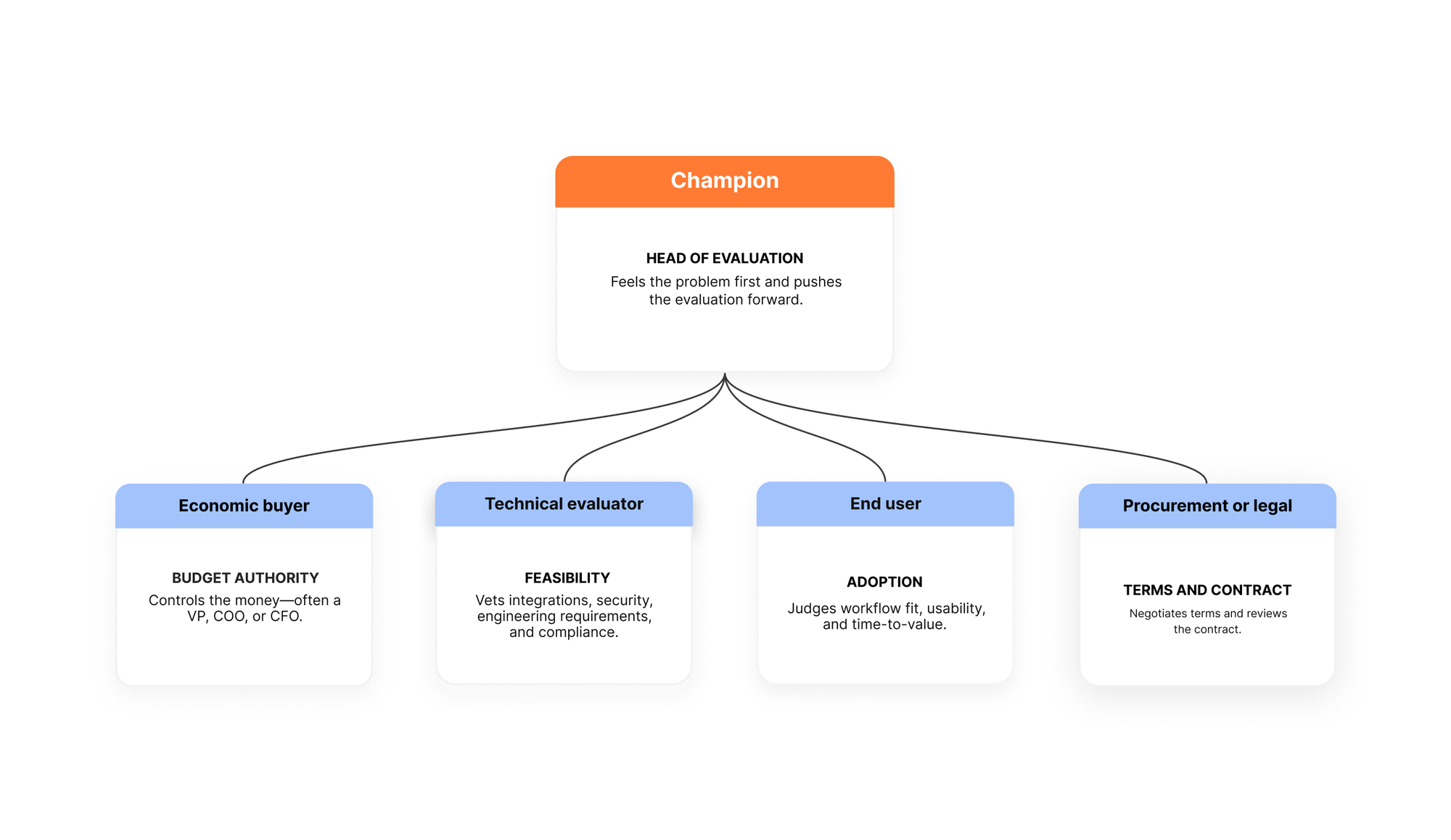
- Champion - the internal advocate who feels the problem first and pushes the evaluation forward.
- Economic buyer - usually a VP, COO, or CFO. someone who controls the money.
- Technical evaluator - IT, security, or engineering. The person or team who vets integration and checks for compliance.
- End user - the person who uses the product daily. Cares about workflow fit and time-to-value.
- Procurement or legal - negotiates terms and reviews the contract.
B2B buying group insights
Even if there’s only one person per role, there is going to be friction. Roughly three-quarters of buying teams report unhealthy conflict during a decision since every department has different priorities.
And the instinct to smooth that over by personalizing your message to each stakeholder tends to backfire: Gartner has found that tailoring a pitch too specifically to one individual can actually lower group consensus, because it leaves the room with fewer shared reasons to agree with each other.
And that is the room actually optimizing for—not one voice, but all of them, and increasingly, a model standing in front of most of them.
How do you optimize a B2B buyer journey for AI search?
If half your buyers are starting in a chatbot instead of Google, a handful of things will move whether you show up in the answer.
- Open every page with a 40–60 word answer to the exact question in the headline.
- Fill out your profile on the two or three review sites your category actually gets cited on.
- Pull up your pricing page, your G2 listing, your LinkedIn, and any partner pages side by side. Pick one wording for each feature name and price point, then go fix every instance that doesn't match. Models cross-check sources against each other.
- Pull the last 20 sales call transcripts or support tickets and lift the actual questions verbatim. Turn each into its own FAQ heading with a two- or three-sentence answer.
- Block 15 minutes a month to run your top 5 category questions through ChatGPT, Gemini, and Perplexity, and log whether you're mentioned, cited, or missing entirely.
What this means is: don't optimize for the one voice in the room you can hear the loudest. Optimize for the shared ground the whole room needs before anyone signs.
Frequently asked questions
What is a B2B buyer journey?
A B2B buyer journey is the process a buying group follows from an unnamed friction to a signed vendor decision—starting well before anyone types a query into a search engine or a chatbot.
How many people are in a B2B buying group?
Gartner puts the average B2B buying group at 6 to 10 stakeholders. Forrester's 2026 research runs higher, at 13 internal stakeholders plus 9 external influencers for a typical decision, climbing further for complex or enterprise purchases.
Why are B2B buyers using AI chatbots instead of Google?
Because a chatbot hands back one synthesized, narrowed answer instead of ten links to sort through. G2's March 2026 survey found 51% of B2B decision-makers now start their research in a chatbot rather than a search engine.
How is a buyer's journey ever evolving?
It keeps shifting because the tools buyers use to research keep shifting. Most recently, that's the move from search engines to AI chatbots, which changed where a shortlist actually gets built and who—or what—builds it first. The stages haven't changed as much as when and where each one happens.
How does generative engine optimization impact the B2B buyer's journey?
Generative engine optimization (GEO) determines whether you show up inside the single synthesized answer a chatbot gives a buyer, instead of as one link among many on a results page. Since 51% of B2B buyers now start there, missing GEO means missing the narrowing stage of the journey entirely, before a buyer ever reaches your site.
How do you track a B2B buyer journey across sales and marketing?
By connecting what marketing sees—content engagement, chatbot visibility, verification-page behavior—with what sales sees: win-loss interviews, objections actually raised in the room, who was really in the buying group. Neither side has the full picture alone; the map earlier in this piece is one way to line the two up.